

When we’re working with new clients, there comes a time to discuss investments. This stage always comes after the initial Financial Planning work, where we have got to know them, their dreams, desires and plans for the future – and after we have constructed a Financial Plan to make best use of their resources to achieve those goals.
When talking about investments, new clients sometimes ask us questions like:
- Which boosst portfolio does your average client use?
- What’s the average return of a boosst portfolio?
- Is that a better return than the average investment?
Let’s take a look at each of these questions…
Which boosst portfolio does your average client use?
This question makes us smile. People are hard-wired to go along with the crowd – as we all just want to be liked and accepted. The desire to fit in is so strong that people sometimes conform to a group consensus even when it goes against their own judgment. We provide our clients with personal advice, that matches the best investment solution to their personal needs. Conforming to a crowd is not a safe bet in personal finance, as there is a very good chance that your pathway is not the same as everybody else’s.
What’s the average return of a boosst portfolio?
When it comes to investing, knowing the ‘average rate of return’ is only a very small part of the overall picture – so an average alone can be very misleading and unhelpful.
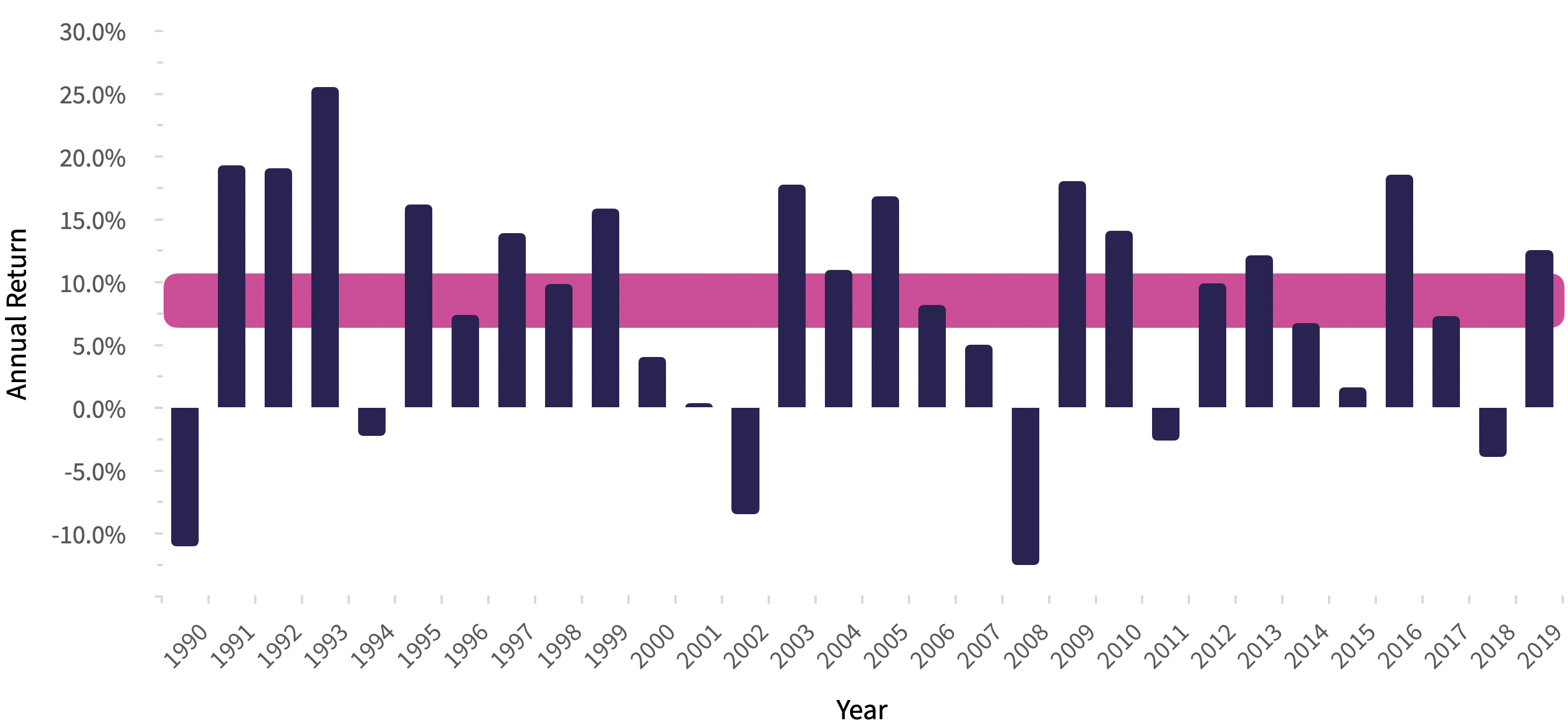
Since 1999, the boosst 60 portfolio has rewarded investors with an average annual return of 8.4% – however it is imperative to remember that returns in any specific year may be high, poor, or somewhere in between. The dangerous thing about ‘average’, is that humans love to project forwards; so simply knowing what a past average is, creates an inner expectation of similar return each year in the future.
This graph illustrates the point by showing that annual returns have been as high as 25.5% and as low as -12.5%. Annual returns were positive in 14 years and negative in 6. In fact, annual returns only came within 2% of the average return on 6 occasions (shown by the pink area).
This is the ‘bumpy road to average’. It is simply wrong to expect a smooth return when investing for capital growth.
Whilst it may be comforting to expect an ‘average return’ in the future, at boosst, we feel it is important for our clients to understand the range of potential outcomes, as knowing this can help you stick with a plan and ride out the inevitable ups and downs. (See Note 1 below)
Is that a better return than the average investment?
As it happens, the boosst portfolios have performed exceedingly well compared to their peers. We recently produced a comparison of the boosst portfolios against 416 of the most popular multi-asset funds from 73 of the largest fund managers. Our boosst 60 portfolio outperformed 88% of it’s competition who took an equivalent level of risk – and our more cautious boosst 40 portfolio performed better than 94% of it’s peers, over the last 8 years. (See Note 2 for further information). So the good news is that ‘yes’ – boosst portfolios have performed well compared to their peers.
It is important to remember that the ‘average return’ of an investment reflects its long-term past performance, not what it will do in the next 12 months or 10 years. As the graph above shows, investments are exposed to markets that both rise and fall in value, and long-term investors are guaranteed to see both sides of this. The secret is to not become overjoyed when investments rise sharply, as we expect it to happen – but equally do not become anxious or uneasy when investments fall, as we expect it to happen.
Some other important considerations are:
How long are you investing for? The graph above highlighted that the historical ‘average return’ is not a useful representation of the bumpy road ahead for an investment. Investing in something with a high average return is not at all clever, if it demands that you accept an extremely volatile investment journey – especially if you need to access your funds within the next few years. The amount of time that you expect to invest for has a direct influence on assessing whether an investment portfolio is suitable for you. Our role is to ensure we build an understanding of what your future will look like, so we know when you will need to access your investments, so that we ensure that you hold investments suitable for that time horizon.
How comfortable are you with watching your long-term savings rise and fall in value? By positioning an investment to achieve greater long-term returns, you are also inviting greater short-term risks. For example, investors who hold higher risk portfolios with large equity holdings will have suffered a sharper fall in value when the COVID-19 pandemic began earlier this year. Those same investors are also likely to have seen a sharper recovery since March. If you use an investment portfolio which makes you feel uneasy, you are more likely to panic and withdraw funds after they have fallen, which is certainly not a good thing! Our role is to get to know you, and ensure that you only take investment risks that you are comfortable with.
How much risk do you need to take? This is a more nuanced question, which most people struggle to answer with confidence. We believe that proper Financial Planning with a detailed cashflow projection for your family’s financial future, is the only way to address this conundrum. This gives an accurate projection of your future financial position – making it easy to understand when you will need to access investments to supplement your income or fund larger expenses. This is the advantage that our the full boosst clients benefit from.
We sometimes find that clients have already accrued sufficient assets to achieve all that they wish to – which is a great position to be in. In this case, the investor is already financially independent – so their main investment objective is often to simply maintain the ‘real value’ of assets (by outpacing inflation). Continuing to take higher levels of investment risk, which may put finances at risk of short-term falls, is unlikely to appeal to a family in this position. On the other hand – a family who are still accruing their assets may accept higher risks in pursuit of healthy investment returns, to help them achieve their long-term goals sooner. Our role as Financial Planners is to help people understand if they are on-track to achieve their goals – and adjust their investment strategy to suit their long-term objectives.
Note 1: The historical performance figures quoted are purely for discussion purposes. The stated performance is net of any fees deducted by the underlying funds but does not take in to account any fees deducted by a custodian, who hold your investments for you, or by the Financial Planner that arranged and maintains the investment for you – in this case, boosst.
Note 2: This research was conducted within Morningstar, a leading investment analysis tool. Frustratingly our license doesn’t allow us to share graphs publicly, but if you would like to see the research behind theses figures, just ask us at your next planning meeting and we will be very happy to show you.
Please be aware that the information we have shared in this Insight is for information purposes and is not individual advice. We make a conscious effort to check that all links to third party websites remain active and correct however we cannot take responsibility for their content or their availability.