
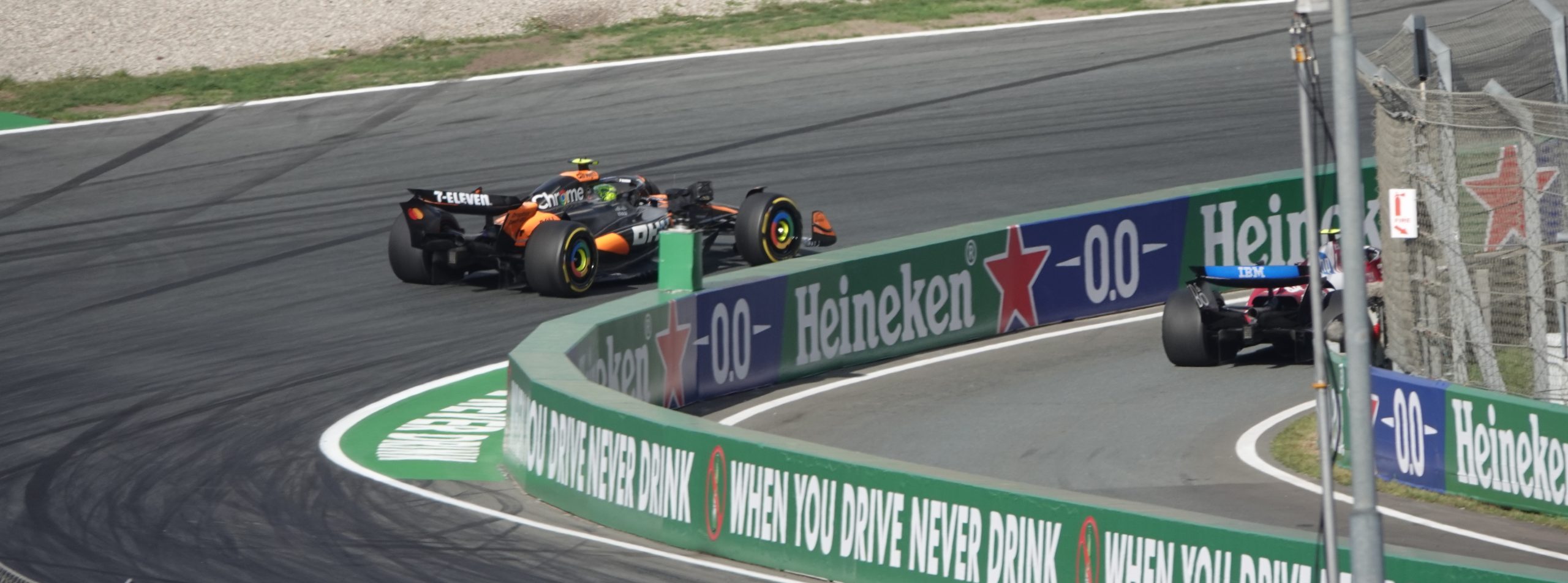
The F1™ season kicked off in Melbourne yesterday, with boosst clients in attendance both as spectators and representing teams at Victoria Park. This marked the beginning of a new era under new regulations and the product of a winter of extraordinary effort – often more than a thousand engineers at each team, thousands of hours of design, simulation, and testing – all of it in service of getting two cars around a circuit as quickly as possible. It is a staggering feat of human ingenuity, and it contains some interesting lessons for financial planning…
Built for one condition
It is well documented that Formula 1™ cars are built around a single, uncompromising objective: speed. Everything else is a trade-off made in pursuit of speed, and the results are extraordinary – at 200 miles per hour, with enough downforce generated to theoretically drive inverted through a tunnel, an F1™ car operates at the very edge of what physics permits. It is spectacular precisely because it has been ruthlessly optimised for one condition.
But let’s be clear – an F1™ car is not designed to be stationary, and the moment it stops moving, the car begins to work against itself!
The tyres fall out of their operating temperature window within seconds. The brakes cool faster than the car can compensate for. The engine management system requires active intervention just to keep the power unit alive. Each car carries more than 500 sensors feeding data back to the engineers in real time – and before every qualifying lap, the team spends the entire out-lap managing those readings – warming the tyres to their precise operating window, cycling the brakes, monitoring systems – because if even one component falls outside its ideal range, the car will simply not perform as it was designed to. The engineering is so precisely calibrated to one set of conditions that any deviation from them becomes a problem to be managed rather than absorbed.
And when things go wrong – as they occasionally do at 200 miles per hour – the car is not built for it. Carbon fibre leaves the chassis. Components that weigh almost nothing, because every gram has been engineered out in the pursuit of lap time, simply cannot absorb the kind of forces that an unplanned impact generates. The car is extraordinary in the conditions it was designed for, and fragile in every other condition.
Don’t be inspired by F1™ when building your financial plan
There is a version of financial planning that works just like F1™. It is the version that optimises everything for performance and gets to the end of the race with a dribble of fuel left in the tank. It’s easy to spot, as it generally features a dependence on achieving certain investment returns, holding back on expenditure and memory-making, and/or retiring as soon as the stripped back plan suggests is viable – all the while, with no slack in the system. On paper, it can look impressive, with a retirement age projected to be earlier than previously thought possible. In practice, it is built for one condition: conditions where nothing unexpected happens, where health holds out, and where plans unfold precisely as modelled. As financial planners who support hundreds of families, we would suggest that life is not those conditions.
A financial plan that is only engineered for the soonest possible retirement or reliant upon unreasonable investment returns has no crumple zones, and no capacity to absorb the forces that a real life generates. It has no space for the redundancy that arrives three years before retirement was planned. It has no tolerance for supporting an adult child through divorce or ill health. It would have no answer for the inheritance that was relied upon being spent instead on care fees. It certainly cannot absorb the premature death of a partner, which changes not just the emotional landscape but the entire financial one – the income that disappears or the retirement that now looks entirely different for the person left behind.
It also cannot account for the ways that the world simply changes around the plan. A financial plan built in 2005 was almost certainly built with assumptions about spending patterns, technology, and lifestyle costs that have since become unrecognisable – nobody modelled a £1,000 phone as a normal annual household expense and nobody anticipated the subscription economy. Looking forward, the plans we are building for clients today include a car – perhaps two or more – as a pattern of fixed costs within the household budget, but if technology continues at the rate it is currently moving, it is entirely plausible that car ownership simply fades from the picture, replaced by a world where you hail a vehicle when you need one and pay for the time you use. The cost structure of a family’s life in 2046 may look genuinely different from the one we are modelling today, and a plan with no flexibility to accommodate that shift is not a robust plan.
You must therefore avoid the temptation to approach building a financial plan as you would build an F1™ car.
A real plan built for a real life
At boosst, we think about financial planning a little differently. A plan should start not from an investment performance target but from a life – specifically, the three distinct phases of the life you are planning for.
The first is your current lifestyle – the years in which you are working, typically building, and funding everything that comes next. The second is your desired lifestyle – the point at which you have seven Saturdays a week and the freedom to do whatever you choose with them. For some people that means full retirement; for others it means continuing to work in some form, but on their own terms and at a flexible pace of their choosing, because the financial pressure is gone and work becomes something they do because they want to, not because they have to. The third phase is what we call your later years, and this is typically dictated not by an intentional decision but by health – or more accurately, by the gradual shift in what you actually want to do. If we offered to pay for a fifty-year-old to fly to New Zealand tomorrow, the answer would most likely be yes – they would take the free trip. If we made the same offer to a seventy-five-year-old, even with every cost covered, the answer is more likely to be no – nothing to do with the cost – we’re still paying, and sometimes not even because their health prevents it, but simply because the desire is different. Your later years phase is the point at which spending naturally begins to contract, often without anyone consciously choosing it.
A well-built plan accounts for all three phases and models the transitions between them honestly. What does enough look like in each? What would need to be true for you to arrive at the later years of your life with no regrets about the choices you made? And what has changed in the past twelve months – in your health, in your thinking, in what matters to you – that we should be discussing as a reason to adjust the assumptions your plan is built on?
That last question is why our client relationships run on an annual cycle. Not simply to discuss annual investment returns, or because our regulator requires an annual suitability review of your products – that all matters, and it’s important to our clients that they are getting great investment outcomes delivered in a compliant way – but it is the smaller part of the conversation. The real purpose of our annual planning meetings is to openly discuss what has changed in your life since we last sat down together. Is there something you want to do with your time on earth that you were not thinking about a year ago? Has a conversation with a doctor, or a death in the family, or simply a birthday with a significant number on it, changed how you are thinking about the years ahead? The plan needs those answers, because without them it gradually drifts from the life it was designed to serve.
What resilience actually looks like
We see that the clients who find the most freedom in life are rarely the ones who tried to optimise every variable. They are the ones whose plan was built with a wider surface area from the beginning – with enough flexibility to absorb what life generates, in both directions.
A healthy liquid buffer – money that is accessible and not subject to market conditions – means that when investments next dip in value, as they periodically do, you are not a forced seller at the wrong moment. You can wait. The buffer absorbs the shock while the plan holds its shape, in the same way that having a pit lane available means a car can come in without destroying the race.
Connected to this is one of the most under-appreciated risks in retirement planning: the sequence of returns you experience matters just as much as the average return your portfolio achieves over the period. Every boosst financial plan is built on a set of growth assumptions – reasoned, grounded in evidence, and deliberately slightly conservative – but those assumptions reflect an average over decades, and life does not deliver averages in any particular order. If you retire at the beginning of a significant market decline and begin drawing on your portfolio to fund your desired lifestyle, the combination of falling values and regular withdrawals can deplete the pot far more rapidly than the modelled scenario, even if markets recover strongly over the following decade. The same average return, experienced in a different sequence, produces a very different outcome. The reverse is equally true: retire into a strong run of markets and your estate may grow well beyond what the plan projected, which sounds like welcome news but can quietly become an inheritance tax problem if your plan isn’t recalibrated. A robust plan is stress-tested against both scenarios from the outset, and the annual planning meeting is the mechanism for responding to whichever sequence you are actually experiencing – spending more confidently when returns are running ahead, and making considered adjustments to discretionary spending if they are not.
Protection – life cover, income protection, and critical illness cover – is not an add-on but a load-bearing element of the plan. Without it, a serious health event or early death does not just affect the family emotionally; it can destroy the financial structure that was built to support them. Building protection in properly from the beginning is the equivalent of engineering the crumple zones into the car rather than hoping the impact never comes.
Giving yourself options: If you arrive at retirement with the vast majority of your savings concentrated in one persons’ pension, you have built a plan with limited flexibility around how and when you can access the money, constrained by the tax system, which itself is subject to change. A key consideration for us as financial planners supporting clients who are accumulating their wealth is to ensure it is spread across different structures – pensions alongside ISAs and other tax wrappers. This is less about investment performance and more about creating optionality, as it gives the plan more ways to respond to whatever the future holds.
On the topic of care: Statistically, the majority of people will not require significant later-life care, so we generally do not build it in as a standard assumption – doing so is wrong more often than it is correct. We also know, however, that the clients who have supported a parent or grandparent through the care system often carry a strong instinct that they will face the same – and for those clients, seeing the impact of care modelled within the plan is genuinely useful. It does not change the probability, but it changes how they feel about what they have built, and for some people that reassurance is worth more than the number itself. Regardless of whether care fees have been built into the final plan, they are always considered, and having a known funding mechanism in place if it is required brings great peace of mind and again, reduces the list of things which are unplanned and could know you off course.
Health: Perhaps the most important variable of all, and one which is overlooked surprisngly often. Not just your lifespan, which is how long you will live for, but importantly your healthspan – as more healthy years means more years in your desired lifestyle phase – so that’s more years of seven Saturdays a week, more years to spend the money you spent decades building, more years in which the plan is delivering what it was designed for. Investing in your health with the same seriousness you brought to your retirement savings is not simply a lifestyle observation. It is financial planning.
What should you take from this?
Well, what struck me while watching the first race of this new season is how much effort goes into those two cars, and how precisely that effort is calibrated for the ninety minutes of racing ahead. The engineering is genuinely extraordinary, and the single-mindedness that produces it is extraordinary too. But please remember that the goal of all of that effort is a finish line, not a life. Your financial plan has a very different job, and it deserves to be engineered differently.
If you don’t yet have a comprehensive lifestyle lead financial plan, or if you do but it is built in excel, reach out to the boosst team to learn more about how we can support you. The first step is an Intro Call with myself, where we will explore your aspirations and whether working with boosst will add value to your life.
If you got this far, thank you for taking the time to read my thoughts. Aside from contacting us (HERE), you may also like to read our favourite book “Enough? How much money do you need for the rest of your life?” which you can download from here for free: LINK
Josh
boosst is an independent employee-owned financial planning business based in Bedfordshire. We work with around 500 families who want a plan that is built around their lives, not just their portfolios.
Images used are my own. F1 and Formula 1 are trademarked terms, we have no formal links or affiliations to F1™.